Wild Indigo. What’s in a name?
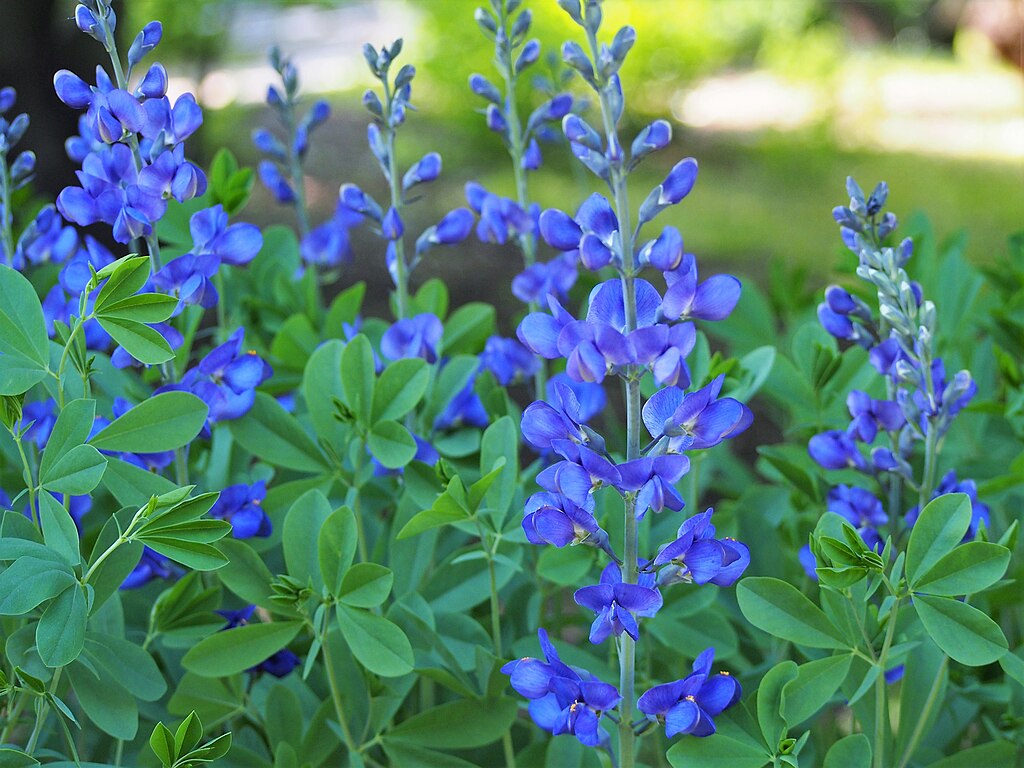
Perhaps you can simply look at this color and understand why we chose wild indigo.
The color hums and sings.
The color vibrates.

This particular species is called Baptisia australis, meaning the Baptisia of the south. Baptisia is derived from to word baptize.

Baptisias are native to North America and produce more than 20 species with many more subspecies and variants. The most commonly cultivated species is our friend Baptisia australis. Those blue purple flowers are hard to resist. The other species range from creamy white to bold yellow, but I mean really, look at that indigo color.

A Natural Dye.
The name indigo relates to the Native American use of the stems as a blue dye. The word indigo was used for another pea family plant called Indigofera tinctoria, the tropical source of indigo dye.
We prefer the name wild indigo rather than false indigo. Somehow using the name false to describe a plant seems disrespectful.
But wild, is… wild.
We love it.
Another name is rattlebush. A tribute to the seed pods that were used as tiny rattles to entertain babies by both indigenous folk and early settlers.

Habitat and Habit.
Wild indigo is hardy, thriving even when soils are poor and droughts are long. Its perennial taproot reaches deep into the soil for buried nutrients and moisture. The foliage dies back each season, and springs forth when soil temperatures warm.
The foliage is distinct with leaves split into threes and typical pea-like flowers and pods. In the late summer, the seed pods turn dark purplish-black and are roomy enough to allow the bean-like seeds to shake around and rattle.

Insects & Microorganisms.
Wild indigo is in the Fabacea family thus a pea plant that attracts microorganisms to the nodules on its roots where they deposit nitrogen into the soil.
Apion rostrum, the aptly named seed weevil, of course, lays its eggs in the green seedpods providing baby weevils instant access to nutrition before they go on their merry way.
Wild indigo hosts many butterflies and bees. The leaves provide sustenance for the larvae of the Black-Spotted Prominent moth, Hoary Edge, Frosted Elfin, Southern Dogface, and Orange and Clouded Sulfur butterflies, Eastern Tailed-Blue and, of course, the Wild Indigo Duskywing. Leaf damage is minimal, maybe they can only handle so many quinolizidine alkaloids before they move on.
Bumble bees are particularly fond of wild indigo. The female bumble bees collect the pollen in their pollen baskets and then use them to lay eggs.

Medicinal Uses.
Native Americans taught early settlers many medicinal uses of wild indigo. Topically the root was used for skin infections, ulcers, and wounds. A decoction of the root was taken for symptoms of infection including fevers, respiratory congestion, and gastrointestinal distress.
Cherokee uses include a poultice as a gynecological aid ‘to allay inflammation and stop mortification,’ for toothache, as a cathartic, and as both emetic (hot infusion) and anti-emetic (cold infusion).
The Osage made an eyewash from the plant (part not specified).
The dark colors of the dead leaves, rattles, and root are a signature for dying tissues and deep stagnant infections.
The medicinal qualities are attributed to baptisin (bitter quality), coumarins, quinolizidine alkaloids (which are toxic at large or extended doses), saponins, polysaccharides, and flavonoids.
Herbal actions include antiemetic, anti-inflammatory, antimicrobial, astringent, cathartic, digestive, emetic, emmenagogue, febrifuge, immune stimulant, laxative, purgative.
The physical qualities of the root are cool and dry due to its bitter taste.
Today, the root of wild indigo is often tinctured or used in a decoction as an immune stimulant to help in the recovery of infections.

Research.
Findings are slim. Very little clinical research has been done. One clinical study suggests efficacy and safety when combined with Echinacea and Thuja. Another study on the use of Baptisia for neurological uses found that it has only mild anti-anxiety and anti-stress effects suggesting there are safer plants to use.
Warnings.
Do not use while pregnant or nursing. May be contraindicated for some gastrointestinal diseases or conditions.
Dose.
Use short-term only, and always use lowest therapeutic dose. Large or prolonged doses can lead to nausea, diarrhea, and/or vomiting.
Tincture: 1 mL 3 times a day
Decoction: 1/2 oz by weight per 32 fl.oz, 3 cups per day or use as a poultice
Homeopathy.
Baptisia tinctoria is the most common species sourced for homeopathic remedies. Specific indications for use of the remedy are confusion, scattered thinking, a sense that the body and/or organs scattered, fragmented, or disorganized, feelings of disconnect, inability to get comfortable especially when resting, sometimes worse with movement and hot humid conditions, especially at night, flu-like symptoms with high fever, weakness, sweating, exhaustion, heaviness, infection, body and breath odors are offensive perhaps smelling like rot, and skin may be dark red with patches.
Sources.
https://www.xerces.org/blog/bumble-bees-and-baptisia-pollination-story
https://ozarkedgewildflowers.com/native-plants/blue-false-indigo-baptisia-australis
Hamel, Paul B. and Mary U. Chiltoskey, 1975, Cherokee Plants and Their Uses — A 400 Year History, Sylva, N.C. Herald Publishing Co
https://en.wikipedia.org/wiki/Cherokee_ethnobotany
USDA/NRCS Plant Guide: Blue Wild Indigo
http://www.namethatplant.net/article_baptisia.shtml
https://christopherhobbs.com/herbal-therapeutics-database/herb/wild-indigo/
https://www.herbalreality.com/herb/wild-indigo/
Naser B, Lund B, Zepelin HH, Köhler G, Lehmacher W, Scaglione F. A randomized, double-blind, placebo-controlled, clinical dose–response trial of an extract of Baptisia, Echinacea and Thuja for the treatment of patients with common cold. Phytomedicine. 2005;12(10):715-722. https://doi.org/10.1016/j.phymed.2005.03.002
Central Nervous System Activity Studies of Baptisia tinctoria (L.) R. Vent. RootsJanuary 2017, International Journal of Pharmacology Phytochemistry and Ethnomedicine 6:1-7
DOI:10.18052/www.scipress.com/IJPPE.6.1
https://botanical.com/botanical/mgmh/i/indwil06.html
https://thenaturopathicherbalist.com/herbs/b-2/baptisia-tinctoria/
https://homeopathycenter.org/materia-medica/baptisia/
https://www.homeopathyschool.com/the-clinic/self-help-remedies/baptisia-tinctoria/
